Why Jam Made From Frozen Fruit Sets Differently
Quick Answer: Freezing ruptures fruit cell walls, which releases more water and more free pectin but also exposes pectin to enzymes during thawing. The usual result is jam that runs, plus a darker colour and extra foam. Fix it by draining and reducing the thaw liquid separately, adding about 10% more acid in the form of lemon juice, and cooking in smaller batches — not by adding more sugar.
You did the responsible thing in July. Two kilos of berries, washed, frozen flat, labelled.
Now it is September, the pan smells fantastic, and the jam is refusing to sheet off the spoon after 20 minutes of boiling.
The recipe is not wrong and neither are you. Frozen fruit is genuinely a different ingredient from fresh, and almost no recipe says so.
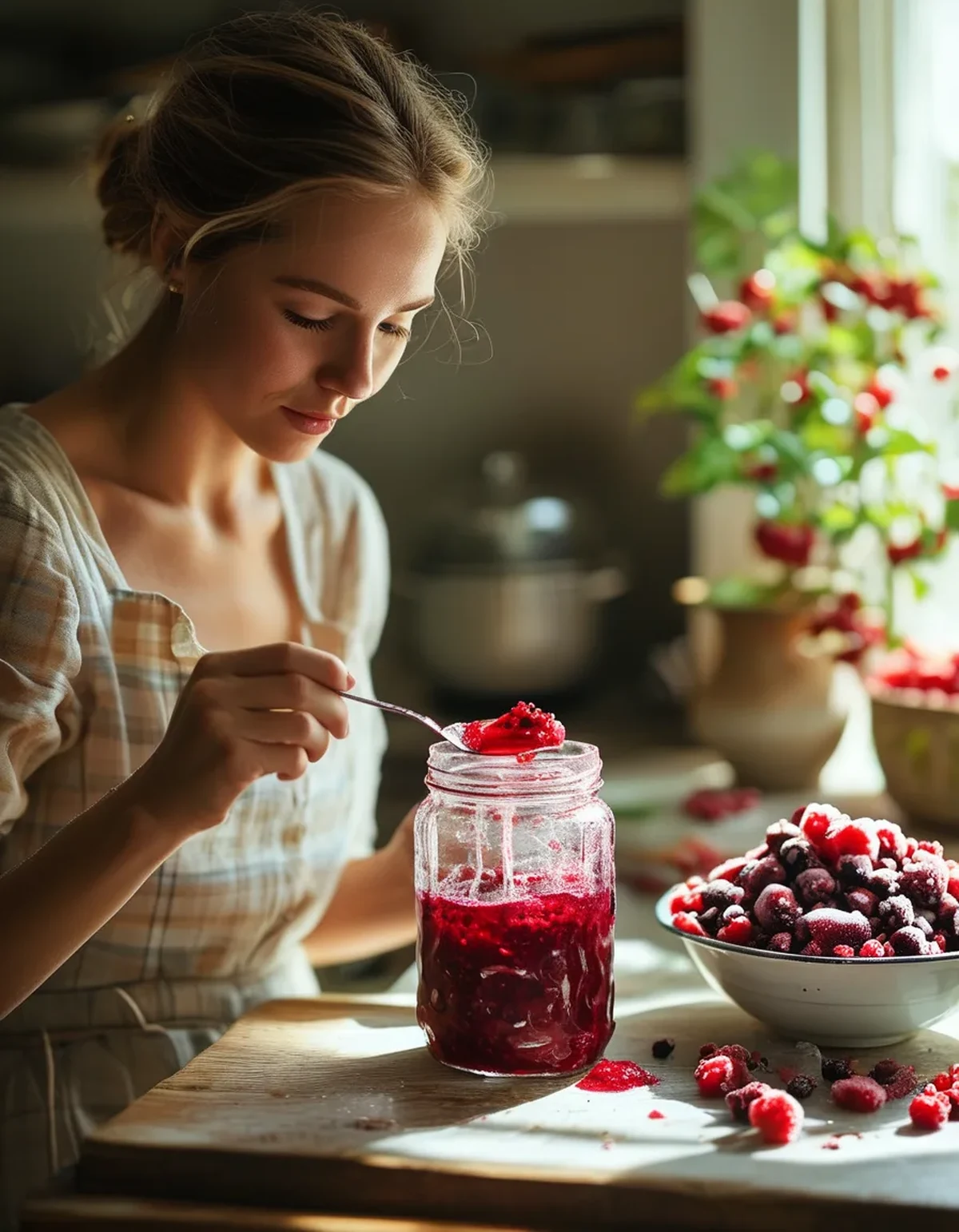
What does freezing actually do to fruit?
It breaks the structure, and the structure was doing several jobs.
When fruit freezes, water inside the cells forms ice crystals that puncture cell walls from the inside. Slow freezing makes larger crystals and more damage; fast freezing makes smaller crystals and less. Home freezers freeze slowly.
On thawing, three things follow:
Free liquid escapes. Fruit that held its water inside intact cells now sits in a pool of it. Frozen-then-thawed berries can shed 15 to 25% of their weight as liquid.
Pectin is released early. Some of this is genuinely helpful — the pectin is more available than in fresh fruit.
Enzymes get to work. Pectin-degrading enzymes that were separated from pectin by cell structure are now mixed with it. During a slow thaw at room temperature, they have hours to break long pectin chains into short ones. Short chains do not gel.
That last point is the one that decides whether your jam sets, and it is almost entirely determined by how you thaw.
Why does the set fail even with the same sugar and cooking time?
Because the water balance and pectin quality have both shifted.
A gel needs three things in the right proportion: pectin, acid and sugar, in a solution concentrated enough to hold together. A standard jam sets at roughly 65% soluble solids, which is what the setting-point temperature of about 104 to 105°C actually measures.
Frozen fruit throws off that balance in two directions at once. Extra released water means you need longer boiling to reach the same concentration. And longer boiling degrades pectin, especially in a low-acid environment.
So the fruit that needs more cooking is the fruit that tolerates it least. That is the trap, and it is why “just boil it longer” so often produces a jam that is simultaneously overcooked and under-set.
There is a colour cost too. Extended boiling drives caramelisation and browning reactions, which is why frozen-fruit jam often ends up several shades darker than the fresh version.
How should you thaw fruit destined for jam?
Deliberately, and preferably not at room temperature.
Best option: do not fully thaw at all. Put the frozen fruit straight into the pan with the sugar and start over a low heat. The fruit passes through the enzyme-active temperature range quickly and the enzymes are denatured by heat before they do much damage.
Second best: thaw in the fridge, in a colander over a bowl, for 8 to 12 hours. Cold slows enzyme activity substantially, and the colander separates the liquid you will want to handle separately.
Worst: thaw on the counter for several hours. This is the standard approach and it is the one that produces the loosest set — hours at room temperature is exactly the condition pectin-degrading enzymes want.
Handle the drained liquid separately. Reduce it hard in a wide pan on its own until it is syrupy, then add it back. You keep the flavour and lose the excess water without subjecting the fruit to that whole boil.
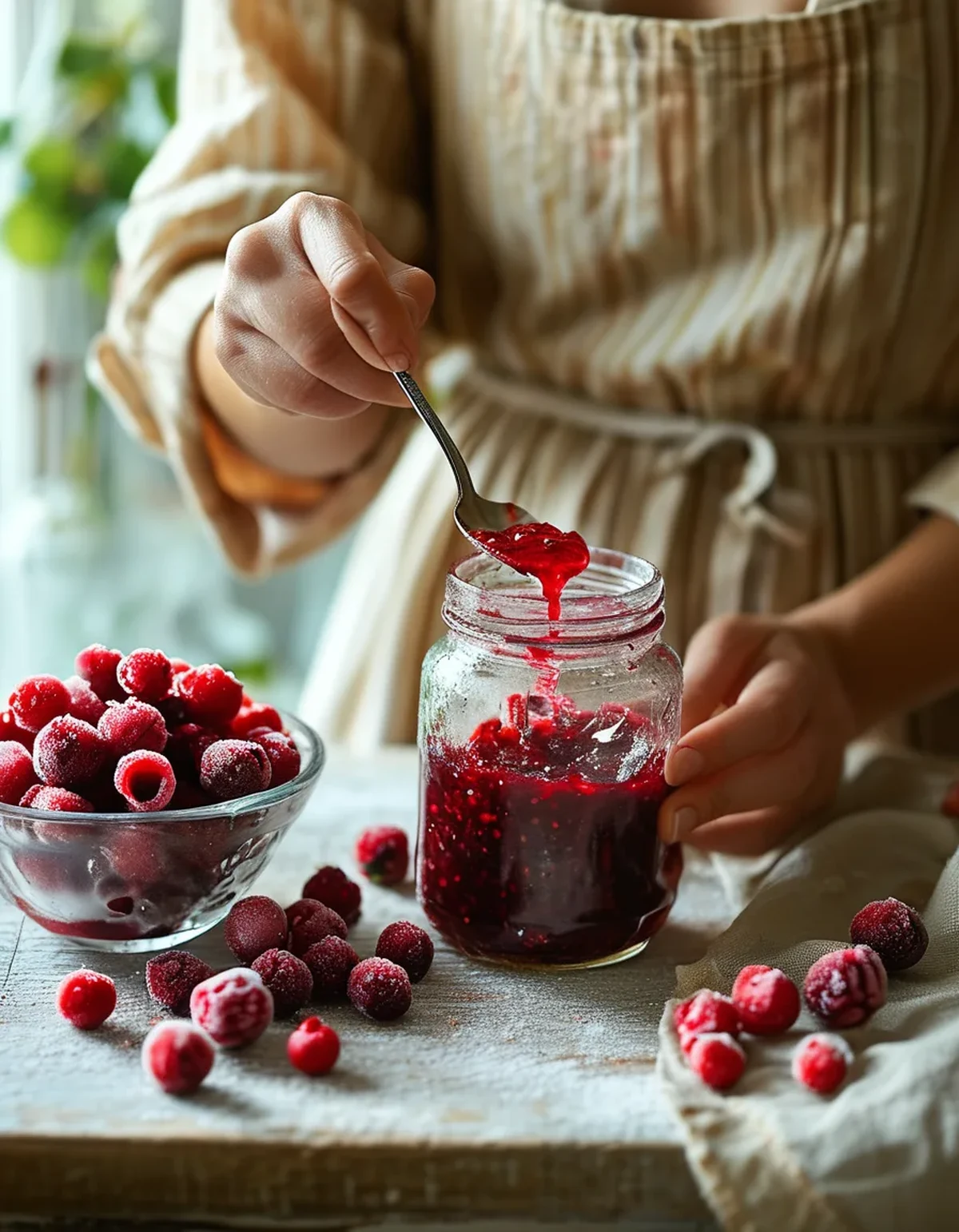
5 Mistakes People Make With Frozen-Fruit Jam
1. Adding more sugar to force a set. Sugar above about 70% does not improve gelling and produces a sticky, over-sweet jam that can crystallise in the jar.
2. Skipping added acid. Frozen fruit often needs about 10% more acid than the fresh equivalent. For a standard 1kg batch that means roughly an extra tablespoon of lemon juice. Acid both helps the gel form and protects pectin during the boil.
3. Doubling the batch. Larger batches need proportionally longer boiling because evaporation scales with surface area, not volume. Keep frozen-fruit batches to 1 to 1.5kg of fruit in a wide pan.
4. Trusting the fresh-fruit timing. Use the temperature or the cold-plate test, never the clock. The clock in the recipe was written for a different water content.
5. Assuming a runny jam has failed. It has not — it is excellent on yoghurt and porridge, and it can be recooked once with added acid. That third mistake, the batch size, is the one that catches even experienced preservers.
Does this change with late-season and frozen mixed fruit?
It does, and September is when most freezer stashes get used.
Late-season fruit is lower in pectin and lower in acid than the same fruit picked earlier. If you froze fruit picked in late August, you are starting from a weaker gelling position before freezing has done anything at all. That compounds — late fruit plus freezing is the combination most likely to produce a syrup rather than a jam.
Mixed freezer batches vary wildly. A bag holding strawberries from June and blackberries from September contains very different pectin and acid levels. Blackberries and currants are high-pectin allies; strawberries and cherries are not. If your mix leans low-pectin, adding a chopped tart apple or a splash of apple juice is a traditional and effective correction.
Freezer time matters too. Fruit stored more than about six months slowly loses quality through sublimation and oxidation, even at a stable temperature. Older fruit needs a little more acid and makes a slightly darker preserve.
None of this is a reason not to freeze fruit. It is a reason to treat a freezer batch as its own recipe.
FAQ: Frozen Fruit Preserving, Answered
Can I use frozen fruit for water bath canning safely?
Yes. Freezing does not change the acidity of the fruit itself, so the safety profile of a tested high-acid jam recipe is unchanged. Follow tested processing times exactly and do not reduce them for smaller batches.
Will my jam set if I just add commercial pectin?
Usually, yes — and there is nothing wrong with that. Use the pectin type your recipe specifies and follow its own instructions rather than the fruit recipe’s, since added-pectin jams have different sugar and boiling requirements.
Why is frozen-fruit jam foamier?
Ruptured cells release more protein and other surface-active compounds. A small knob of butter at the end, or simply skimming, handles it. The foam is harmless — it just traps air and clouds the jar.
Follow tested recipes from a reputable food-preservation source for anything you intend to store at room temperature.
TL;DR:
- Freezing ruptures cell walls, releasing extra water and exposing pectin to enzymes that shorten it during a slow thaw.
- The set fails because you need more boiling to hit 65% solids, and more boiling degrades the pectin you have left.
- Cook straight from frozen or thaw cold in a colander, reduce the drained liquid separately, and add about 10% more acid.
- Keep batches to 1 to 1.5kg and judge by temperature or the cold-plate test, never by the recipe’s clock.
Your July self did nothing wrong. Frozen fruit just needs its own set of rules, and once you use them, the jam is every bit as good as the fresh-picked version.
Keep Reading
This article is for general informational purposes only and is not medical advice. Always consult a qualified health professional for guidance specific to you.