Why Does the Water Level in Your Canner Matter More Than the Timer?
Quick Answer: Water bath canning times assume your jars are covered by at least one to two inches of vigorously boiling water for the entire processing time. If the water drops below the jar lids partway through, the top of the jar contents never reaches the temperature the recipe was validated at, and the processing time becomes meaningless regardless of what the timer says. Top up with boiling water and restart the full time if jars become exposed.
You set the timer for fifteen minutes. You watched it count down. You pulled the jars.
And somewhere in minute nine, the waterline dropped below the lids and you did not notice.
The timer was right. The process was not.

What is the water actually doing in there?
The water is not just heating the jar. It is the mechanism that guarantees a specific temperature at every point inside the jar, including the coldest one.
Boiling water at sea level holds a steady 212°F, and it transfers heat to every submerged surface at the same rate. That consistency is the whole reason processing times can be published as a number. A tested recipe is really a statement that says: at this jar size, with this food density, submerged in boiling water, the slowest-heating point in the center of the jar will reach a safe temperature within this many minutes.
Remove the submersion and the statement collapses. The part of the jar sitting in air is being heated by steam and radiant heat, which is far less efficient and far less predictable.
So the headspace at the top of the jar — the part where problems concentrate, because it holds the most air — becomes the part getting the least reliable heat. That is exactly backwards from what you want.
How much water is actually enough?
The standard is one to two inches above the tops of the jar lids, maintained for the whole processing time.
Not level with the lids. Not just covering them. One to two inches over.
That margin exists for a reason: a rolling boil is violent, and a canner loses water to evaporation faster than most people expect. A vigorous boil in an uncovered canner can drop the level by an inch in ten to fifteen minutes. If you started level with the lids, you are exposed within minutes.
The fix is boring and completely reliable:
- Start deeper than you think. Two inches above, not one, especially for anything processed longer than twenty minutes.
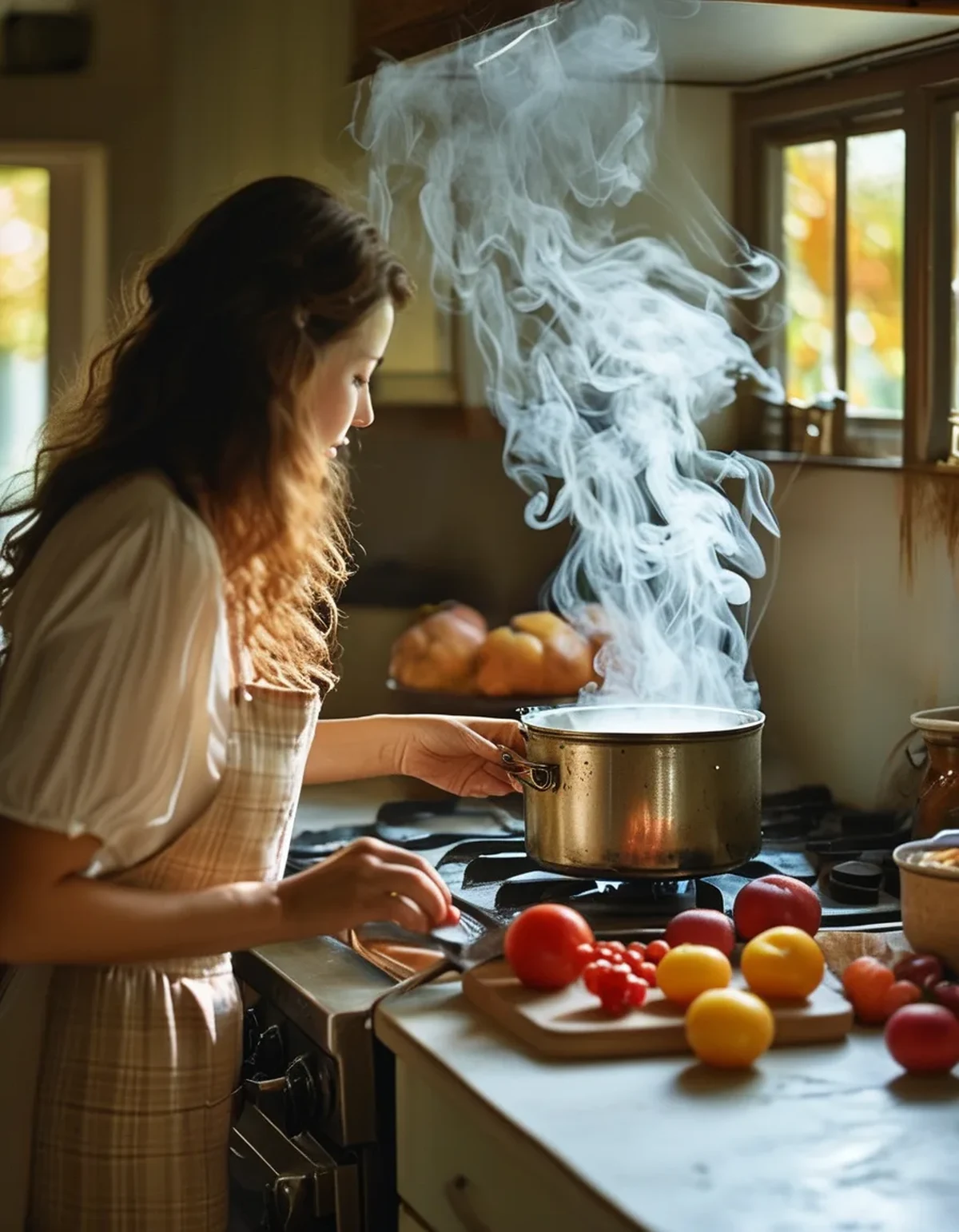
- Keep the lid on the canner. This alone cuts evaporation dramatically and helps the water return to a boil faster after the jars go in.
- Keep a kettle of boiling water going. If you need to top up, it has to be boiling water. Cold water drops the canner below boiling and you will have to restart timing.
That last point catches people. Topping up with tap water feels like the obvious solve and it silently ruins the batch.
What happens if I notice the jars were exposed?
The rule is unambiguous and unpopular: if the water dropped below the tops of the jars at any point during processing, add boiling water to bring it back above the lids, return to a full rolling boil, and restart the entire processing time from zero.
Not the remaining time. The whole time.
This feels wasteful, and the temptation to reason your way out of it is strong — it was only for a couple of minutes, the jars were still hot, it was almost done. The problem is that you have no way to know how far the cold spot inside the jar fell, and no way to know how long it will take to recover. The published time is the only validated number you have, and it only applies to a fully submerged process.
The alternative, if restarting is not practical, is to treat the batch as refrigerator preserves. Label them, put them in the fridge, and eat them within the timeframe appropriate to that food. That is a completely legitimate outcome and considerably better than storing an unvalidated jar in a cupboard for eight months.
What you should not do is seal them, shelve them, and hope. Sealing tells you nothing about safety. A jar can seal perfectly and still be underprocessed.
5 Mistakes Everyone Makes With Canner Water
1. Filling the canner before loading the jars. The jars displace water. Fill partially, load the jars on the rack, then top up to the correct depth. Otherwise you either overflow or misjudge the level.
2. Starting the timer before the water returns to a full boil. Adding cool jars drops the water temperature below boiling. Timing starts when the water is boiling vigorously again — which can be several minutes after the jars go in.
3. Turning the heat down once it is boiling. A gentle simmer is not a water bath process. You need a steady rolling boil for the full duration. Turning it down to stop splashing is the most common quiet failure.
4. Using the canner lid as optional. It is not decoration. Without it you lose water fast, the boil is harder to maintain, and your kitchen gets much hotter for no benefit.
5. Forgetting altitude. Above 1,000 feet, water boils below 212°F, and the processing time must be increased. The water level rule does not change, but the time does — and a correct waterline with an uncorrected time is still an underprocessed jar.
Does this change with late-season produce?
The water rule itself does not change. What changes is how much slack you have elsewhere, and late summer removes most of it.
Late-season fruit is riper, which means lower acidity and higher sugar. Lower acidity narrows the safety margin that water bath canning depends on, so the process needs to be executed more precisely, not less. Denser end-of-season tomatoes and thicker purées also heat more slowly at the center, which makes full submersion more important rather than less.
A practical late-August adjustment: add acid as the tested recipe directs, without exception, and do not eyeball it. Bottled lemon juice rather than fresh, because bottled has a standardized acidity and fresh does not.
And give thick preserves the deeper end of the water range. A jar of thin syrup and a jar of dense fruit butter have very different internal heating curves, and the fruit butter is the one that punishes a shallow canner.
The seasonal habit worth building: when the produce gets riper and the batches get bigger, that is precisely when people start rushing — and rushing shows up first at the waterline.
How do you actually keep an eye on it?
Make it visible rather than remembered. The failure mode here is not ignorance, it is attention.
Set a mid-point check. If the process is twenty minutes, set a second timer for ten and lift the lid to look. Ten seconds of looking, once, catches almost every case.
Keep the kettle on the back burner already boiling. If topping up requires boiling a kettle from cold, you will not do it — you will convince yourself the level is fine.
Mark your canner. A line scratched or marked on the inside at the correct depth for pint jars turns a judgment call into a glance. It sounds trivial and it works.
Do not leave the kitchen. The whole processing time is between ten and ninety minutes. Everything that goes wrong in home canning goes wrong during the part where somebody stepped away.
Canning safety is mostly a small number of unglamorous mechanical facts executed consistently. The waterline is the most mechanical of all of them, and it is the one that quietly invalidates everything else when it slips.
FAQ: Canner Water Levels, Answered
Can I use a stockpot instead of a real canner?
Yes, if it is deep enough to hold your jars plus two inches of water plus a few inches of boiling headroom, and if you put a rack in the bottom. Jars must not sit directly on the pot floor — direct contact with the heat source can crack them.
Does hard water or mineral buildup matter?
Only cosmetically. Cloudy film on jars from hard water is harmless. A splash of vinegar in the canner water reduces it if it bothers you, and it has no effect on the process.
What if my jars float?
Underfilled jars with too much headspace can float and expose their lids, which is the same problem by a different route. Correct headspace fixes it. A rack with a hold-down or simply loading a full canner so the jars support each other also helps.
Is steam canning the same thing?
No. Atmospheric steam canning is a separate validated method with its own rules, equipment, and time limits, and it is only approved for high-acid foods with processing times under a certain length. Do not improvise a hybrid by using less water in a water bath canner and calling it steam canning.
TL;DR:
- Processing times are only valid when jars stay covered by one to two inches of vigorously boiling water for the entire time.
- A rolling boil can drop the water an inch in ten to fifteen minutes — start deeper and keep the canner lid on.
- If jars become exposed, top up with boiling water and restart the full processing time from zero.
- Top-ups must be boiling; cold water drops the canner below boiling and invalidates the timing.
- Late-season, riper, denser produce narrows your margin, so precision matters more in August than it did in June.
Of all the things that can go wrong in a home canning session, the waterline is the easiest to control and the easiest to stop watching. Set a mid-point check, keep a kettle going, and mark the depth on your canner. The timer only means something if the water was doing its job the whole time it was counting.
This is general information. For current tested recipes and processing times, follow your national extension service or an up-to-date tested source.
Keep Reading
This article is for general informational purposes only and is not medical advice. Always consult a qualified health professional for guidance specific to you.