Why Vinegar Strength Decides Whether a Pickle Recipe Is Safe
Quick Answer: Tested pickling recipes assume vinegar of at least 5% acetic acid, because that is what brings the finished jar reliably below pH 4.6 — the threshold under which Clostridium botulinum cannot produce toxin. Many artisan, wine, and homemade vinegars are 4% or unlabelled, and substituting one for another can leave a jar above that threshold even though everything looked and tasted normal. Check the label for acidity, not the name on the bottle.
This is one of the few places in home cooking where a small substitution is genuinely not a matter of taste.
And it is the substitution people make most casually.
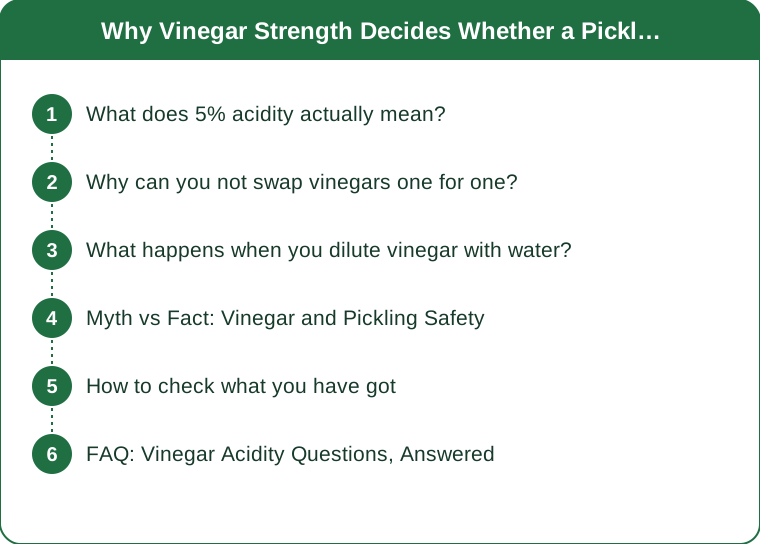
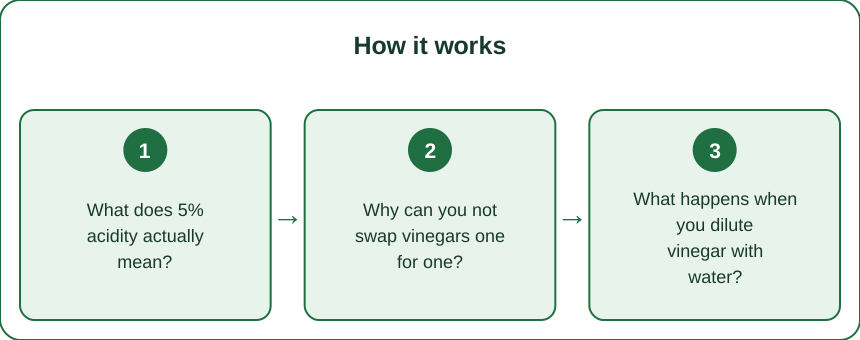
What does 5% acidity actually mean?
It is the proportion of acetic acid by volume in the bottle, and it is the number the whole system is built on.
Standard distilled white vinegar and most commercial cider vinegar are made to 5% acetic acid. Tested water-bath canning recipes are calculated on that assumption. The recipe’s ratio of vinegar to water to vegetables is designed so that after the acid has diffused through the food and equilibrated, the entire contents of the jar sits at or below pH 4.6.
That number is not arbitrary. Below pH 4.6, C. botulinum spores cannot germinate and produce toxin. Above it, they can — in the anaerobic, room-temperature environment a sealed jar provides, which is close to ideal conditions for them.
So the vinegar is not a flavouring in a pickle recipe. It is the preservation mechanism. Reduce its strength and you have not made a milder pickle; you have made a jar whose safety margin you no longer know.
Why can you not swap vinegars one for one?
Because acidity varies far more between vinegars than most people expect.
- Distilled white vinegar: typically 5%, sometimes sold at 6% for pickling
- Cider vinegar (commercial): typically 5%
- Wine vinegar: often 6 to 7%, but sometimes lower — varies by producer
- Rice vinegar: commonly 4 to 4.5%, and many seasoned versions are lower still
- Balsamic: usually 6% but with a large sugar content that changes everything else
- Artisan or unpasteurised vinegars: frequently unlabelled for acidity
- Homemade vinegar: unknown, and can vary batch to batch
Rice vinegar is the most common problem, because it is the natural choice for Asian-style pickles and it is routinely below the required strength. Homemade vinegar is the other, and it is the one where confidence is highest and knowledge is lowest.
If a bottle does not state its acidity, it does not belong in a shelf-stable canning recipe. Use it for refrigerator pickles instead, where the fridge is doing the safety work.
What happens when you dilute vinegar with water?
You move the whole jar toward the threshold, and you usually cannot tell.
Most pickle brines are already a vinegar-to-water ratio — 1:1 is common. That ratio was calculated for 5% vinegar. Use a 4% vinegar in the same recipe and the effective acidity of the brine drops by a fifth. Add extra water because the brine tasted sharp, and it drops further.
The problem is that none of this is visible. The jar seals, the pickles look right, the flavour is arguably nicer. There is no smell, no cloudiness, no sign of any kind. Botulinum toxin does not announce itself, which is exactly why the guidance is conservative.
This is also why you cannot safely reduce the vinegar in a tested recipe to make it milder. If a brine is too sharp for you, the correct adjustments are to add sugar (which does not affect pH meaningfully) or to reduce the pickling time, not to add water or cut the vinegar.
Low-acid vegetables — green beans, carrots, beetroot, cucumbers — depend entirely on the added acid. They have no meaningful acidity of their own.
Myth vs Fact: Vinegar and Pickling Safety
Myth: Any vinegar is acidic enough to preserve.
Fact: Acidity ranges from about 4% to 7% across common vinegars, and the difference spans the safety threshold. The name on the bottle tells you the flavour, not the strength.
Myth: If it tastes sour enough, it is acidic enough.
Fact: Taste does not track pH reliably. Sugar masks sourness substantially — a sweet pickle brine can taste mild and be perfectly acidic, or taste sharp and be borderline. Your palate is not a pH meter.
Myth: Homemade vinegar is stronger because it is unrefined.
Fact: Homemade vinegar is typically weaker and highly variable, often between 3% and 5% depending on the starting alcohol and how long fermentation ran. It is lovely on a salad and unsuitable for shelf-stable canning.
Myth: A long water-bath processing time makes up for weak vinegar.
Fact: It does not. Water-bath temperatures do not destroy botulinum spores — the acidity is what stops them growing. Processing time addresses moulds, yeasts, and enzymes. This is the point that surprises even experienced cooks: heat and acid are doing two different jobs, and one cannot substitute for the other.
How to check what you have got
Three steps, in order.
1. Read the label. Acidity is usually printed near the volume or in the nutrition panel, expressed as a percentage or as grain (50 grain = 5%). If you cannot find it, assume you do not know it.
2. Match the recipe’s assumption. Almost all tested recipes from reputable extension services assume 5%. Using a 6 or 7% vinegar is safe — more acid is not a hazard, only a flavour decision. Using anything under 5% is not.
3. When in doubt, refrigerate. Refrigerator pickles are the correct home for interesting low-acidity vinegars, homemade vinegars, and your own ratios. They keep for weeks, they taste excellent, and refrigeration is doing the safety work rather than the acid.
A few extra habits worth having:
- Buy vinegar for canning specifically, and keep it separate from cooking vinegar
- Do not reuse pickle brine for a second batch — its acidity has been diluted by the water in the first batch of vegetables
- Follow a tested recipe from a reputable source rather than adapting one, for anything going on a shelf
General food safety guidance varies by country; follow your national or regional authority for shelf-stable preserving.
FAQ: Vinegar Acidity Questions, Answered
Can I test the pH at home?
Paper strips are too imprecise for the 4.6 decision — they typically read in whole or half units, and you need better resolution than that. A calibrated digital pH meter can do it, but home canning guidance generally recommends following a tested recipe rather than testing your own, because pH also needs time to equilibrate through the food.
Is 6% vinegar better than 5%?
Safer, yes — more acid is never a hazard in this context. It will taste sharper, so you may want to increase the sugar slightly. Never go the other way.
What about lemon juice instead of vinegar?
Bottled lemon juice has a standardised acidity and is used in many tested recipes, particularly for tomatoes. Fresh lemon juice varies considerably between fruits and is not recommended as a substitute in shelf-stable canning for exactly the reason this article is about.
Does the vinegar lose strength over time in the cupboard?
Not meaningfully if the bottle is sealed. Once opened, acetic acid is stable, though flavour compounds fade. An old sealed bottle of 5% vinegar is still 5%.
TL;DR:
- Tested pickling recipes assume 5% acetic acid vinegar, which brings the jar below pH 4.6
- Rice vinegar, some wine vinegars, and all homemade vinegars are often below 5%
- Taste does not indicate pH — sugar masks acidity completely
- Longer processing does not compensate for weak vinegar; heat and acid do different jobs
- If the label does not state acidity, make refrigerator pickles instead
This is the one substitution in preserving worth being genuinely strict about. Everything else in a pickle jar is a matter of preference — the vinegar strength is the part doing the actual work, and it is the part you cannot check by looking.
This is general information, not a substitute for tested recipes from your national food safety authority. When preserving for the shelf, follow a tested recipe from a reputable source.
Keep Reading
This article is for general informational purposes only and is not medical advice. Always consult a qualified health professional for guidance specific to you.