The One Canning Safety Variable That Actually Matters Most
Quick Answer: Acidity level is the single most important canning safety variable — low-acid foods (most vegetables, meat) require pressure canning, not water-bath canning, because only high heat under pressure reliably kills botulism spores. This is general information, not a substitute for tested USDA canning guidelines.
Jar sterilization gets most of the beginner attention, but it’s not actually the variable that determines whether home-canned food is safe. Acidity is — and getting this wrong is the real risk in home canning.
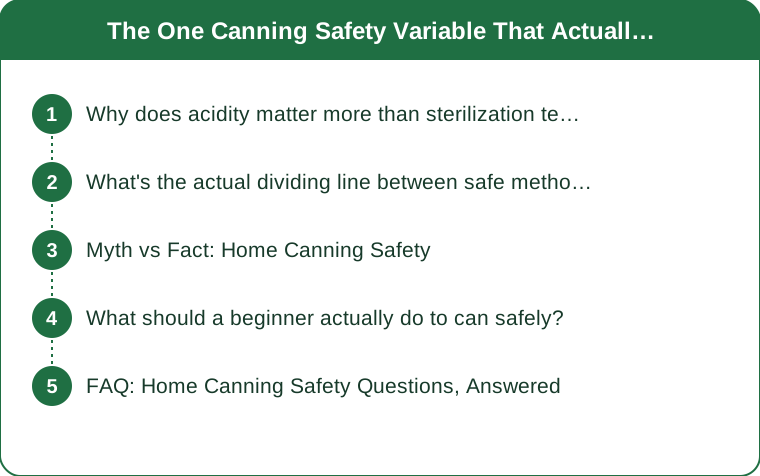
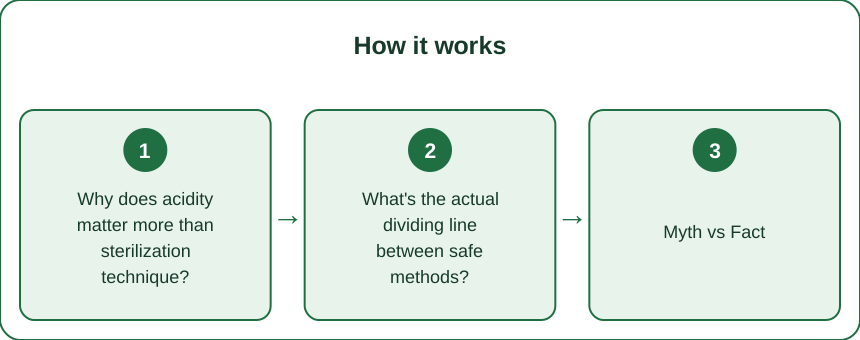
Why does acidity matter more than sterilization technique?
Botulism spores survive boiling temperatures (212°F) but are killed by the higher temperatures reached in pressure canning (240°F+), or by an acidic environment that prevents them from growing even if present. This is why the acid level of what you’re canning determines the entire required method — sterilizing jars perfectly doesn’t matter if the method itself can’t reach botulism-killing conditions.
What’s the actual dividing line between safe methods?
High-acid foods (most fruits, pickles, tomatoes with added acid, jams) can be safely water-bath canned — the acidity itself prevents botulism growth. Low-acid foods (most vegetables, meats, soups) require pressure canning — water-bath canning these is not a shortcut, it’s a genuine safety failure, regardless of how careful the rest of the process was.
Myth vs Fact: Home Canning Safety
Myth: If jars seal properly, the food inside is safe. Fact: A proper seal only means the container is airtight — it says nothing about whether harmful bacteria were killed during processing, which depends entirely on matching method to acidity.
Myth: Adding more vinegar or lemon juice to any recipe makes water-bath canning safe. Fact: Only tested, verified acid levels from a trusted recipe (like USDA or extension office guidelines) are reliable — eyeballing acidity additions isn’t a safe substitute for tested ratios.
Myth: Grandma’s untested recipe has worked for decades, so it’s fine. Fact: Years without incident doesn’t confirm safety — botulism risk is rare but severe, and ‘it’s always been fine’ isn’t a safety guarantee.
What should a beginner actually do to can safely?
Use tested recipes only from a source like the USDA Complete Guide to Home Canning or a state extension office — not internet recipes without verified processing times. Match the method to the food: pressure can anything low-acid, water-bath only high-acid. Use a reliable pressure canner with a gauge, and check it’s calibrated correctly if it’s been a few years.
FAQ: Home Canning Safety Questions, Answered
Can I water-bath can vegetables if I add enough vinegar?
Only if following a specific tested recipe designed for that acidity level — improvising acid ratios for typically low-acid vegetables isn’t a reliable safety method.
How do I know if a canning recipe is actually tested and safe?
Look for recipes from USDA, university extension offices, or Ball/Bernardin’s official tested recipe collections — these have verified processing times and acid levels.
What are the signs a canned food might be unsafe to eat?
A bulging lid, off smell upon opening, spurting liquid, or visible mold are all reasons to discard without tasting — when in doubt, throw it out is the standard rule for home-canned food.
TL;DR:
- Acidity level determines safe method — this matters more than jar sterilization
- High-acid foods: water-bath canning works. Low-acid foods: pressure canning required
- A good seal doesn’t confirm bacteria were killed — method matching does
- Use only tested recipes from USDA or extension office sources, not improvised ones
This is general information — always follow tested USDA or extension-office canning guidelines for your specific recipe.
Keep Reading
This article is for general informational purposes only and is not medical advice. Always consult a qualified health professional for guidance specific to you.