The One Home Canning Safety Variable Most Beginners Overlook Completely
Quick Answer: Altitude adjustment to processing time is one of the most commonly overlooked home canning safety variables, since water boils at a lower temperature at higher elevations, meaning standard processing times calibrated for sea level may not reach a safe temperature to kill bacteria at higher altitudes.
It’s easy to follow a canning recipe’s timing exactly and still end up with an unsafe result if you live somewhere well above sea level and didn’t adjust for it.
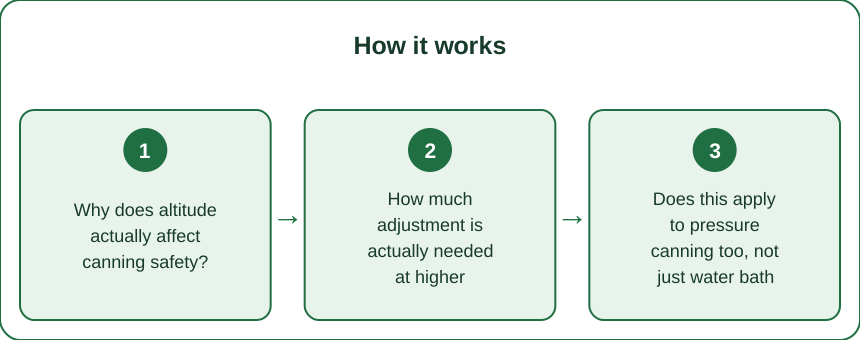
Why does altitude actually affect canning safety?
Water boils at progressively lower temperatures as elevation increases, since there’s less atmospheric pressure pushing down on the liquid. A boiling water bath at 5,000 feet reaches a genuinely lower temperature than the same process at sea level, which means the same processing time may not sufficiently kill harmful bacteria and spores at higher elevations, even though the water is still visibly boiling.
How much adjustment is actually needed at higher elevations?
Most official canning guidelines add processing time in tiers based on elevation — commonly an extra 5 minutes for 1,000-3,000 feet, up to 20 additional minutes for elevations above 8,000 feet, depending on the specific recipe and method. These aren’t small, optional adjustments — they’re the difference between a processing time that reaches safe temperature and one that doesn’t.
Does this apply to pressure canning too, not just water bath canning?
Yes, though the adjustment works differently — pressure canning requires increasing the pounds of pressure used rather than the processing time, since pressure is what compensates for the lower boiling point at altitude in that method. Both canning methods need some form of altitude adjustment; the type of adjustment just differs by method.
Myth vs Fact: Canning and Altitude
Myth: If the water is boiling, the process is working the same everywhere. Fact: Boiling water at high altitude is genuinely cooler than boiling water at sea level, which affects processing safety.
Myth: Altitude adjustments are only necessary for extreme elevations like mountain towns. Fact: Adjustments typically start around 1,000 feet, which includes many cities well below what people consider “high altitude.”
Myth: A recipe that doesn’t mention altitude is safe to use as-is anywhere. Fact: Reliable canning recipes should include altitude adjustment charts — if one doesn’t, it’s worth cross-checking with an official extension service resource.
FAQ: Home Canning Altitude Questions, Answered
How do I find my exact elevation for canning adjustments?
A quick search of your city or zip code’s elevation, or checking your phone’s built-in altitude feature, gives an accurate enough number for canning adjustment charts.
Where can I find a reliable altitude adjustment chart?
University extension service websites (like those affiliated with USDA guidelines) publish detailed, tested altitude adjustment tables for both water bath and pressure canning.
What happens if I under-process due to a missed altitude adjustment?
Under-processed canned food carries a real risk of harmful bacteria survival, including botulism risk — if you suspect a batch wasn’t processed correctly for your altitude, it’s safer to discard it than take the risk.
TL;DR:
- Water boils at a lower temperature at higher elevations, which affects canning safety
- Processing time (water bath) or pressure (pressure canning) both need altitude-based adjustment
- Adjustments typically start around 1,000 feet, not just extreme mountain elevations
- Reliable canning recipes should include an altitude adjustment chart — cross-check if one doesn’t
This is general information, not a substitute for a tested canning guide — check your elevation against a university extension service’s official adjustment chart before your next canning session.
Keep Reading
This article is for general informational purposes only and is not medical advice. Always consult a qualified health professional for guidance specific to you.