How to Tell If Last Year's Canned Jar Is Still Good
Quick Answer: Check the seal first — a lid that flexes or pops when pressed means the seal failed and the jar goes out regardless of appearance. Then look for cloudiness in clear liquid, bubbling, an unusual color, a bulging lid, or any spurting when opened. When any of those appear, discard without tasting. Quality declines after about 12 to 18 months even in a perfectly sealed jar.
This is the week the new jars need shelf space and the back row from last August is still sitting there. Some of it is fine. Some of it is not, and the difference is not always about age.
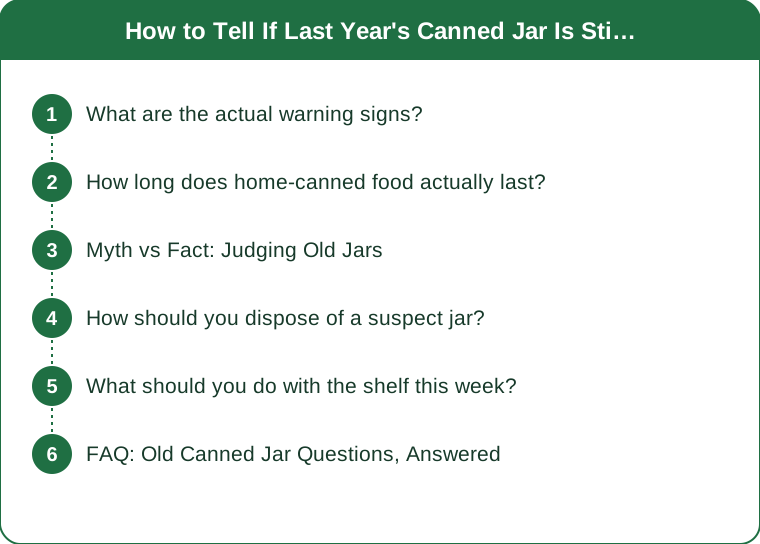
What are the actual warning signs?
Work through them in this order, because the first one rules out the rest.
1. The seal. Press the center of the lid. It should be firmly concave and not move at all. If it flexes, clicks, or pops, the seal has failed and the contents are not safe, no matter how good they look. On a two-piece lid, also try lifting the jar by the lid alone — a properly sealed lid holds.
2. The lid surface. Any bulging, upward doming, or rust that has penetrated through means discard.
3. The liquid. Cloudiness in something that should be clear, unexplained sediment, or any bubbles rising when the jar is still is a serious sign.
4. The contents. Mold of any color, unusual darkening beyond normal, slime, or a texture change.
5. The opening. Liquid that spurts, foams, or forces the lid up as you open it means gas pressure inside, which means microbial activity.
6. The smell. Off, fermented, yeasty, or simply not what it should be.
The rule that governs all of this: when in doubt, throw it out, and never taste to check. The organism most people are worried about produces a toxin that is dangerous in extremely small amounts and cannot be detected by taste.
How long does home-canned food actually last?
Two different questions get mixed up here — safety and quality — and they have different answers.
Safety: A properly processed, properly sealed jar stored in a cool dark place stays safe more or less indefinitely, as long as the seal holds. Age alone does not make a sealed jar unsafe. What makes a jar unsafe is a processing failure, which was present from day one, or a seal failure that happened later.
Quality: This declines on a predictable schedule. The general recommendation is to use home-canned goods within 12 to 18 months for best quality. After that you get color loss, texture softening, flavor flattening, and gradual nutrient degradation. It is still safe; it is just not as good.
Storage conditions dominate quality more than time does:
- Temperature is the biggest factor. A pantry at 50 to 70°F preserves quality far better than a garage that swings from 40 to 90
- Light degrades color and some nutrients, which is why dark storage is specified
- The rings should come off after sealing. Left on, they trap moisture, hide a failed seal, and cause rust
So the practical answer for your back row: if it is from last August and sealed and stored well, it is safe and probably still decent. From two summers ago, it is likely safe and noticeably declined.
Myth vs Fact: Judging Old Jars
Myth: If it smells fine, it is fine. Fact: The most dangerous form of spoilage in low-acid canned goods can be entirely odorless and produces no visible change. Smell is a useful signal when it is bad, and no reassurance at all when it is good.
Myth: Boiling suspect food makes it safe. Fact: Boiling for ten minutes does inactivate the toxin in question, and this is genuinely part of official guidance for low-acid home-canned vegetables. But it is a precaution for jars you have no reason to suspect — not a rescue for a jar showing spoilage signs. A jar with warning signs should be discarded, not boiled.
Myth: Cloudy pickle brine means spoilage. Fact: Not always. Cloudiness can come from table salt with anti-caking agents, hard water, or ground spices. But it can also indicate spoilage, and if you cannot attribute it to a known cause, treat it as suspect.
Myth: A sealed lid proves safe processing. Fact: A jar can seal perfectly and still have been under-processed. The seal tells you air has not gotten in since; it says nothing about whether the processing was adequate in the first place. This is why following a tested recipe matters more than any post-hoc inspection.
How should you dispose of a suspect jar?
Carefully, and this part gets skipped in most discussions.
If a jar shows any sign of spoilage, do not simply pour it down the drain and rinse the jar. Standard guidance for a suspect low-acid jar:
- Do not open it if it is bulging or leaking. Place the whole sealed jar in a heavy garbage bag, seal it, put that in a second bag, and dispose of it where children and animals cannot reach it
- If it is already open, the safest approach is to detoxify by boiling the container and contents in water for 30 minutes, then discard
- Wear disposable gloves and avoid any contact with skin
- Clean any surface the contents touched with a fresh bleach solution — one part unscented household bleach to five parts water — and leave it wet for several minutes before wiping
- Discard sponges and cloths used in the cleanup
This level of caution applies to genuinely suspect low-acid jars. A jam that has grown surface mold or a jar whose seal simply failed in storage is a much smaller matter — that one goes in the trash and the jar goes in the dishwasher.
Knowing the difference is the point. Most failures are ordinary. A small number are not, and the cost of over-caution is one jar of green beans.
What should you do with the shelf this week?
A twenty-minute annual pass that makes next year easier.
- Take everything off and check every seal. This is the whole safety pass and it takes ten minutes
- Remove any rings still on jars, and check underneath for rust or moisture, which is where failures hide
- Sort by date and move oldest to the front. If your jars are not dated, start dating them this year with a marker on the lid
- Note what you actually ate. The single most useful piece of information for this year’s canning is which jars you reached for and which sat untouched for two seasons. Make less of the second thing
- Check the storage spot itself — is it actually cool and dark, or has it become the warmest cupboard in the house because of where the fridge got moved?
- Wipe the shelf and put the new batch at the back
The timing is deliberate. Doing this before the late-summer preserving push means you know how much room you have, what you are short of, and what you should not bother making again.
FAQ: Old Canned Jar Questions, Answered
The lid is sealed but there is liquid loss. Is that a problem?
Some liquid loss during processing is normal and does not affect safety as long as the seal is intact. Food above the liquid line may darken or dry out, which is a quality issue. Significant loss that happened after processing is worth treating as suspect.
My jam has crystallized. Is it spoiled?
No. Sugar crystallization is a quality issue caused by sugar concentration and storage temperature swings. It is unappealing but harmless. Mold on the surface is a different matter — discard the whole jar rather than scooping the top, since mold filaments extend well below what you can see.
Can I re-process a jar whose seal failed?
Only if you catch it within about 24 hours of the original processing, and then only with a new lid and full reprocessing time. A jar found unsealed on the shelf months later cannot be rescued — the contents have been at room temperature, unsealed, for an unknown period.
TL;DR:
- Check the seal first — a lid that flexes means discard, regardless of how the contents look
- Sealed and well-stored jars stay safe indefinitely, but quality declines after 12 to 18 months
- Never taste to test; the most dangerous spoilage can be odorless and invisible
- Dispose of genuinely suspect low-acid jars with real caution, double-bagged or boiled first
- Do a full seal check and rotation now, before this year’s batch needs the shelf
Most of what is on your shelf is fine. The value of the annual pass is that you find the one jar that is not, and you go into preserving season knowing exactly what to make more of.
Keep Reading
This article is for general informational purposes only and is not medical advice. Always consult a qualified health professional for guidance specific to you.