Why a Jar That Pinged Can Still Be a False Seal
Quick Answer: The ping only tells you the lid flexed inward at one moment; a real seal is a sustained vacuum holding the lid concave for the life of the jar. False seals — jars that ping and then quietly let go hours or days later — come from food residue on the rim, wrong headspace, siphoning during processing, damaged rims, or fiddling with hot bands. The reliable verdict comes at 12 to 24 hours: press the center, remove the band, lift the jar by the lid edges, and store bands-off so any late failure announces itself.
The ping is the celebration. The next-day check is the actual inspection.

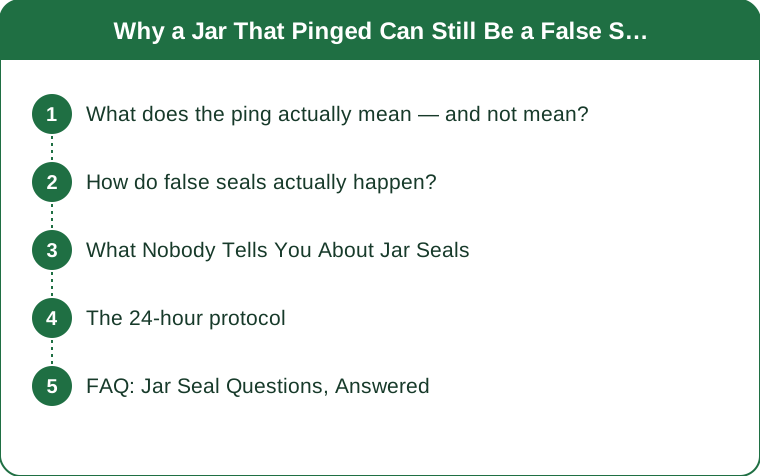
What does the ping actually mean — and not mean?
It means the lid dome inverted. Once.
Modern canning lids have a slightly domed center. As a processed jar cools, the contents contract, pressure inside drops below the room’s, and at some point the dome snaps from bulged to concave — that snap is the ping. It is genuinely evidence that a vacuum existed at that moment, which is why the sound is so satisfying.
Here is what it is not: proof the vacuum will hold. A lid can snap down over a rim that has a fleck of fruit pulp on it, a scratch, or a whisper of syrup drawn under the sealing compound — and hold for now, on the strength of a partial vacuum and a soft gasket, then release quietly over the next hours or days as the compound cools and firms, or as the trapped particle gives the air a path.
The reverse is also true and trips people constantly: some jars seal without any audible ping. They seal silently in the canner or during the first minutes on the towel, and their owners, waiting for a sound that already happened underwater, sometimes press the lids repeatedly to check — which can itself push a marginal lid down into a false seal, a dent that holds by friction rather than vacuum.
So the sound is neither necessary nor sufficient. Enjoy every ping. Count exactly none of them as a verdict, and keep your fingers off the lids until the cooling period is over.
How do false seals actually happen?
Six routes, all of them preventable at the filling stage.
Residue on the rim. A trace of jam, brine, or fat between glass and sealing compound creates a microscopic channel. The lid seats and holds — until the residue shifts, dissolves, or begins to ferment and produce gas. Wiping every rim with a clean damp cloth, and for fatty or sticky products following with a vinegar-dampened wipe, closes this route.
Wrong headspace, either direction. Overfill and expanding food presses into the lid, forcing product into the seal zone. Underfill and there is too much air to evacuate, leaving a weak vacuum that barely grips. The headspace in a tested recipe is a measurement, not a suggestion.
Siphoning. The dramatic bubbling that spits liquid out of jars during processing or fast pressure release can drag food particles right through the sealing zone as it goes. Jars that lost noticeable liquid deserve extra suspicion at the next-day check even when they ping proudly.
Damaged rims. A chip or hairline nick in the glass rim is a permanent leak path. Fingertip-trace every rim before filling; the tenth-of-a-second habit catches them.
Band fiddling. Bands screwed down hard, or retightened while jars are hot, drag the soft sealing compound and can break a forming seal. Fingertip-tight before processing, then hands off entirely.
Tired lids. Reused single-use lids and elderly stockpiled ones seal at a visibly worse rate. New lids are the cheapest ingredient in the jar.

What Nobody Tells You About Jar Seals
Storing with bands off is a diagnostic, not just a tidiness habit. A false seal that lets go under a screwed-on band stays pressed in place, looking sealed while the contents spoil. The same failure with the band off announces itself — the lid loosens, lifts, or shifts when handled. Bands-off storage turns silent failures into visible ones, which is the entire point.
The lid keeps reporting for the life of the jar. Concave and tight is the healthy state, every time you pick one up. A lid gone flat, flexy, or bulged weeks later means gas is being produced inside, and that jar is not a candidate for tasting to check — it is a discard.
An unsealed jar discovered within 24 hours is not a failure of the food. It goes in the refrigerator and gets eaten first, exactly as if you had made a fresh batch — or it gets reprocessed within that window with a fresh lid and a re-checked rim. The only wrong answer is returning it to the pantry on hope.
Pressing the lid during cooling can manufacture a false seal. A pressed dome can stay down by friction without vacuum behind it. The 12-hour hands-off rule exists to protect the evidence.
A ringing-clear ping from the fridge or the counter days later is bad news in disguise — a lid popping back up. The sound of sealing and the sound of unsealing are the same sound. Context is everything.
The 24-hour protocol
Six steps, in order, one minute per batch.
Let jars stand undisturbed 12 to 24 hours on a towel, out of drafts, bands untouched, lids unpressed. Cooling is when the seal cures; interference is how ambiguity gets created.
Press the center of each lid. A sealed lid is rigid and concave, with zero give. Any flex, click, or springback fails the test on the spot.
Remove the band and look at the seal line. Dried product visible under the lid edge is a flag — it marks where liquid crossed the sealing zone during processing.
Lift the jar an inch by the lid edges only, fingertips under the rim of the lid, over the towel it is standing on. A true vacuum carries the jar’s full weight casually. This is the test with no false positives.
Label, date, and store bands off — cool, dark, dry. The band goes back in the drawer, clean and dry, so it neither rusts to the jar nor masks a late failure.
Route the failures immediately: refrigerate and eat within days, or reprocess within 24 hours with a new lid, a wiped and inspected rim, and the full processing time.
A late-summer note for the biggest canning weeks of the year: a hot kitchen slows jar cooling, and the temptation is to carry jars to the counter under the air conditioning vent or crack a window on them. Resist it — fast, uneven cooling encourages siphoning and flat-out thermal breakage. The towel in a calm corner is the professional move, even in August.
When any jar leaves you genuinely unsure, the rule that never fails: when in doubt, refrigerate it or throw it out. Shelf space is cheaper than the alternative.
FAQ: Jar Seal Questions, Answered
Can I reprocess a jar that failed to seal?
Yes, within 24 hours: empty check, fresh lid, wiped and fingertip-inspected rim, correct headspace, and the full original processing time — not a token few minutes. After 24 hours, refrigerate-and-eat is the only route.
Why did a jar unseal after two weeks in the pantry?
A false seal finally letting go, usually helped by microbial gas production inside — residue in the seal zone or under-processing are the usual authors. A jar that unseals in storage is a discard, not a reprocess and not a sniff test.
Do I really need new lids every single time?
For single-use metal lids, yes — the sealing compound is engineered for one compression. Bands are reusable until they rust or dent. If you want reusables, buy lids actually designed for reuse and follow their own checking ritual.
Does altitude change any of this?
Altitude changes processing time and pressure, which is upstream of everything here — an under-processed jar at elevation can ping and still be unsafe regardless of how well it seals. Adjust the recipe for your elevation first; the 24-hour protocol stays identical everywhere.
TL;DR:
- The ping proves a vacuum existed for one moment; a seal is a vacuum that holds — some good jars never ping and some pingers fail.
- False seals come from rim residue, wrong headspace, siphoning, chipped rims, hot band-fiddling, and tired lids — all preventable at filling.
- The verdict happens at 12 to 24 hours: press test, band off, lift by the lid edges, then store bands-off so late failures announce themselves.
- Failed jars refrigerate or reprocess within 24 hours; jars that unseal later are discards.
Run the lift test over a towel on your next batch. Once you have felt a real vacuum carry a full quart, you will never trust a ping again.
Keep Reading
This article is for general informational purposes only and is not medical advice. Always consult a qualified health professional for guidance specific to you.