Why Your Preserves Taste Flat After a Month in the Pantry
Quick Answer: Flavour loss in stored preserves comes mostly from three things: volatile aroma compounds escaping or degrading, slow oxidation of colour and flavour pigments, and light exposure driving both. Heat accelerates all of it. A jar stored in a warm, bright kitchen loses noticeably more character in a month than one in a cool dark cupboard loses in six. The single most effective change is storage location, not recipe.
Most people store preserves where they look nice.
That is usually the worst place in the house for them.
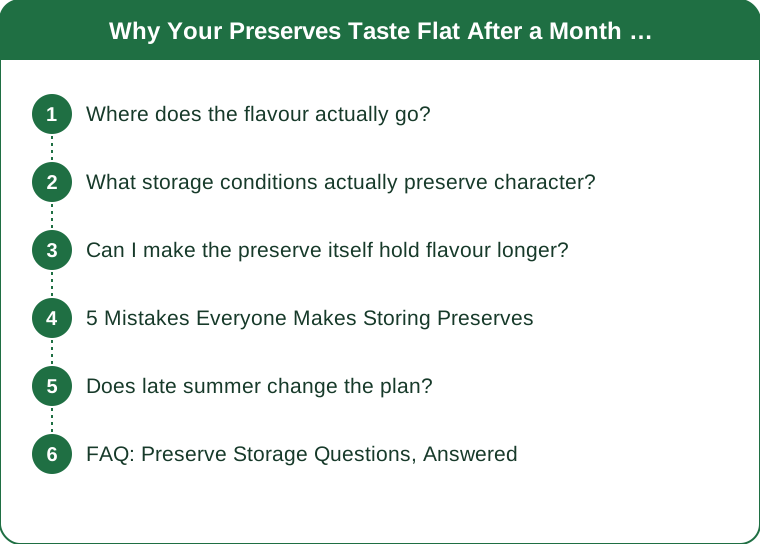
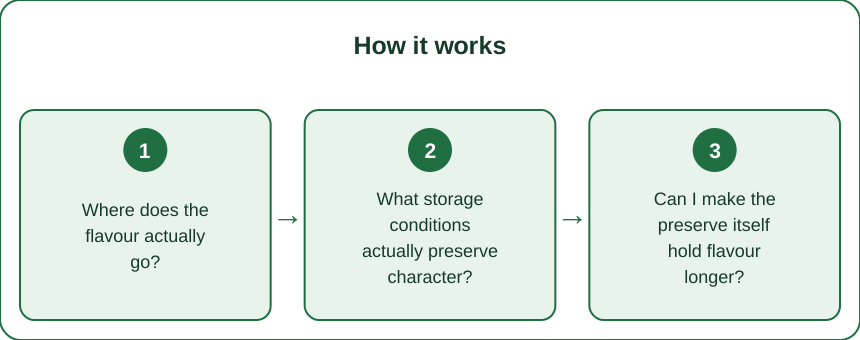
Where does the flavour actually go?
It evaporates, oxidises, and reacts - three separate processes on different timescales.
Volatile aromatics leave first. The compounds responsible for the fresh, lifted top notes of fruit are volatile by definition, and a large share of them are driven off during cooking. What survives into the jar continues to degrade slowly. This is why a preserve tastes most vivid the day it is made and gradually settles into something deeper but flatter.
Then oxidation works on pigments and flavour compounds. Even in a properly sealed jar there is a small headspace containing oxygen. Anthocyanins - the red and purple pigments in berries and stone fruit - are particularly vulnerable, which is why a bright raspberry jam turns brownish-red over months and loses brightness in taste alongside colour.
And non-enzymatic browning continues slowly at room temperature. Sugars and amino acids keep reacting long after the pot comes off the heat, gradually developing caramelised notes that mask fruit character. This is why an older jam tastes more like sugar and less like fruit - not because the fruit disappeared but because other flavours grew louder around it.
All three accelerate with temperature. Rough rule of thumb used across food storage: reaction rates roughly double for every 10°C rise. A cupboard above the stove at 30°C is losing quality several times faster than a basement shelf at 15°C.
And light adds energy to the whole system, particularly for the pigment reactions. A jar on a sunny windowsill is the worst case in every dimension at once.
What storage conditions actually preserve character?
Cool, dark, stable, and upright. In that order of importance.
Cool matters most. Target somewhere in the range of 10 to 20°C, and lower within that is better. The cupboard above the stove or beside the oven is genuinely the worst spot in a kitchen - it can sit ten or more degrees above room temperature for hours a day.
Dark matters nearly as much for anything red or purple. A closed cupboard, a basement shelf, a box. If your jars are decoratively displayed on open shelving in a bright room, they are being bleached and oxidised simultaneously. Keep two or three out for looks and store the rest properly.
Stability matters more than people think. Repeated warming and cooling cycles drive expansion and contraction that can stress seals, and the cycling itself accelerates reactions. A consistently cool 18°C beats a location that swings between 14 and 26.
Upright, always. Contents against the lid can corrode it from the inside and compromise the seal over months.
Remove the screw bands after the seal sets. This is standard canning practice and it has a specific reason: a band left on can hold a failed lid in place and hide a broken seal. Off, wiped, and stored separately.
And label with the month and year. Not for safety - for you, so you can rotate. The system only works if you eat the oldest first.
Can I make the preserve itself hold flavour longer?
Yes. Several choices at the making stage change how it ages.
Cook it for less time at a higher heat. A rapid boil to setting point preserves more aromatic character than a long slow simmer. The total heat exposure is what drives off volatiles, so a shorter, hotter cook that reaches the same set point retains more.
Add a portion of the fruit late. Reserve a quarter of the fruit and stir it in during the last two minutes. Those pieces have had far less heat exposure and carry fresh top notes into the jar. This is one of the highest-impact small changes available.
Acid protects colour and flavour. Lemon juice does more than help the set - it lowers pH, which stabilises anthocyanin pigments and slows browning. It also brightens perceived flavour. If your preserves reliably fade, more acid is often the answer.
Fill headspace correctly. Follow the tested recipe, usually about a quarter inch for jams. Excess headspace means more oxygen in the jar and faster oxidation over months. Do not reduce headspace below what the recipe specifies, though - it is a safety and sealing parameter, not just a quality one.
And consider adding aromatics after cooking rather than during. Vanilla, citrus zest, herbs, and spirits all lose most of their character in a long boil. Stirred in off the heat, they arrive in the jar intact.
One caution: never alter the acid, sugar, or processing time of a tested recipe for water-bath canning. Those are safety parameters. Flavour adjustments belong in the ingredients you add off the heat and in how you store the result.
5 Mistakes Everyone Makes Storing Preserves
1. Storing them somewhere warm because it is convenient. The cupboard by the stove, the shelf above the radiator, the top of the fridge - all significantly warmer than the room and all common storage spots. The top of a refrigerator can run several degrees above ambient from the compressor heat.
2. Displaying them in the light. Jars on an open shelf in a bright kitchen look wonderful and fade fast. Anything red or purple is losing colour visibly within weeks.
3. Leaving the screw bands on. It traps moisture against the lid rim, can cause rust, and can disguise a failed seal. Off after 24 hours.
4. Not refrigerating after opening - or assuming a long fridge life. An opened jar of jam is a fresh food. Most guidance puts opened jam at roughly a month in the fridge, and low-sugar versions considerably less. Trust your nose and eyes.
5. Making a two-year supply of one thing. Preserves are best in the first year and noticeably duller by the second. Making smaller batches more often beats a single enormous batch, both for flavour and because you actually eat it.
And a quiet sixth: forgetting to date the jars. Without dates you cannot rotate, and without rotation the oldest jars stay at the back for years.
Does late summer change the plan?
Yes - this is peak preserving season, and it comes with a specific set of considerations.
Late-summer fruit is at its ripest, which cuts both ways. Very ripe fruit has more flavour and less natural pectin and acid than slightly underripe fruit. A jam made entirely from perfectly ripe August fruit often sets poorly and fades faster. Mixing in some slightly underripe fruit improves both the set and the keeping quality.
Kitchen temperature in August is working against you. Jars cooling in a warm kitchen spend longer at high temperature, which costs you flavour before they even reach the shelf. Cool them somewhere out of the way and away from the still-warm stove, on a rack so air circulates underneath.
Humidity affects seals and labels more than contents. In a humid month, check seals after 24 hours rather than assuming, and store somewhere with airflow to avoid rust on lids.
And this is the moment to think about where the jars will actually live for the winter. The batch you make now will be eaten between November and March. A basement, a cool spare room, or an under-stairs cupboard will keep that batch dramatically better than the kitchen will. Deciding the storage location before you make the batch is the practical version of everything above.
One seasonal bonus: as the weather cools through fall, your storage conditions improve on their own. A jar made in late August and moved to a cool cupboard by October is in good shape for the winter.
FAQ: Preserve Storage Questions, Answered
How long do home preserves actually keep?
Properly sealed and stored, safety is measured in years but quality is measured in about one. Standard guidance is to use within a year for best quality. Beyond that they are typically still safe if the seal is intact but noticeably duller.
Why did my jam darken at the top of the jar?
Oxygen in the headspace, driving oxidation at the surface. It is a quality change rather than a safety problem if the seal is intact. Correct headspace and cool dark storage slow it substantially.
Can I store preserves in the fridge or freezer to keep them fresher?
Yes - refrigerated storage dramatically slows every process described here, and freezer jam is made for exactly this reason. The limitation is space. If you have room for a few special jars in the fridge, they will taste noticeably brighter a year later.
TL;DR:
- Flavour loss is volatiles escaping, oxidation, and slow browning - all accelerated by heat and light.
- Reaction rates roughly double per 10°C, so the cupboard above the stove is the worst spot in the house.
- Cook hot and fast, add a quarter of the fruit late, and put aromatics in off the heat.
- Bands off, jars upright, dated, and stored cool and dark.
- Quality is about one year even when safety lasts longer - make smaller batches more often.
Move your jars out of the kitchen this week. It is the single change that buys the most flavour.
Keep Reading
This article is for general informational purposes only and is not medical advice. Always consult a qualified health professional for guidance specific to you.