Why the Same Jam Recipe Behaves Differently in Late Summer
Quick Answer: The same jam recipe behaves differently late in the season because pectin content falls as fruit ripens — often by half between just-ripe and fully ripe — while sugar rises and acidity drops. Set depends on the pectin, sugar and acid triangle, so late-season fruit needs added acid (lemon juice) and often a proportion of underripe fruit. Nothing is wrong with your technique; the raw material changed underneath it.
July’s batch set like a dream at exactly eight minutes.
September’s, same recipe, same pan, is still syrup an hour after jarring.
The recipe did not fail. The fruit did something different.
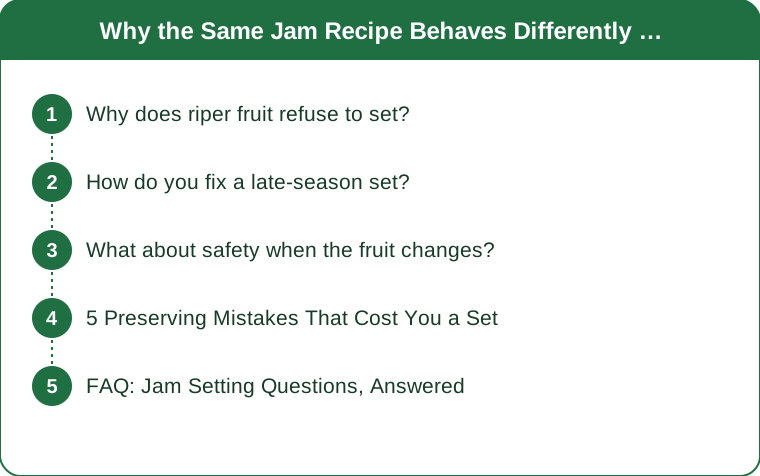
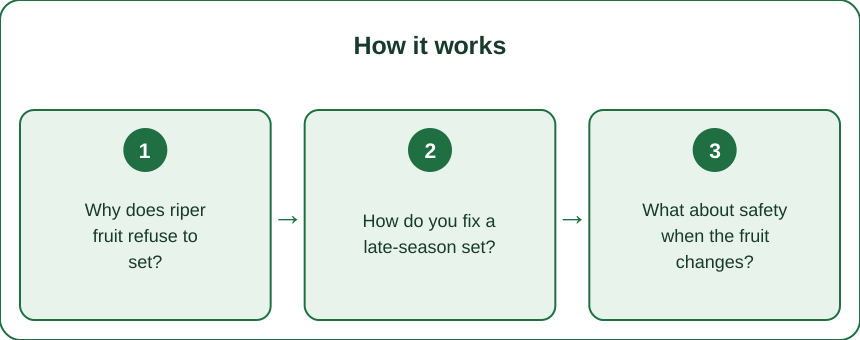
Why does riper fruit refuse to set?
Because ripening is, chemically, the breakdown of the exact thing you need.
Pectin degrades as fruit ripens. Enzymes convert firm protopectin into soluble pectin and then break it down further. Fully ripe fruit can hold half the usable pectin of just-ripe fruit of the same variety.
Acidity falls with ripeness. Pectin needs an acidic environment — around pH 2.8 to 3.5 — to form a gel. Ripe fruit drifts above that range.
Sugar content rises. Helpful for flavour, but it changes the sugar-to-pectin balance the recipe assumed.
Water content varies with the weather. Fruit picked after rain carries noticeably more water and needs longer to reach setting concentration.
Variety matters as much as ripeness. Currants, gooseberries, apples and citrus are pectin-rich; strawberries, cherries, peaches and pears are pectin-poor and always need help.
And the pan changes the timing. A wider pan evaporates faster, so recipe timings only transfer between pans of similar surface area.
How do you fix a late-season set?
Four reliable levers, in order of how much difference they make.
Add acid. Lemon juice at roughly 1 tablespoon per 500g of fruit for low-acid fruit. This is the highest-return single change and it also brightens flavour.
Include underripe fruit. Roughly 20 to 25 percent just-under-ripe fruit restores much of the lost pectin naturally, without commercial pectin.
Make and add apple pectin stock. Simmered cooking apples or crab apples, strained, added at about 10 percent of volume. Traditional, effective, and it does not affect flavour much.
Test properly rather than timing. The cold plate test — a teaspoon on a chilled saucer, pushed with a finger after a minute — beats any clock. Setting point is around 105C if you use a thermometer.
Do not just boil longer. Extended boiling degrades pectin further and caramelises sugar, giving a darker, duller jam that still does not set.
And a failed set is recoverable. Reboil with added lemon juice and either pectin stock or commercial pectin, then retest. Nothing is wasted.

What about safety when the fruit changes?
Acidity is not only a set issue; it is the main safety variable in water-bath preserving.
Water-bath canning is only safe for high-acid foods, meaning pH 4.6 or below. Most fruit qualifies, but ripe low-acid fruit sits closer to the line than people assume.
Added lemon juice is a safety measure as well as a set measure for borderline fruit such as ripe figs, some peaches and tomatoes.
Use bottled lemon juice for safety-critical acidification. Fresh lemons vary in acidity; bottled juice is standardised, which is exactly why tested recipes specify it.
Do not reduce sugar in a tested recipe unless it is designed for it. Sugar contributes to preservation as well as set. Low-sugar preserves need low-methoxyl pectin and usually refrigeration.
Processing time cannot be shortened for smaller batches. Heat penetration depends on jar size, not batch size.
Seasonal note: late-summer gluts are exactly when people improvise off-recipe, and it is the moment to be more careful, not less. Follow a tested recipe from a reputable source for anything going into long storage.
This is general information, not a substitute for a tested canning recipe from a food safety authority.
5 Preserving Mistakes That Cost You a Set
Using the ripest fruit because it tastes best. It tastes best and sets worst. Blend ripeness levels.
Skipping the lemon juice. It looks optional in the ingredient list and it is doing most of the chemical work.
Trusting the recipe’s timing over the cold plate. Timings assume a specific pan, quantity and stove. Yours are different.
Doubling the batch. Larger volumes take much longer to reach setting point and overcook the fruit at the edges. Two separate batches beat one double.
Stirring constantly at a rolling boil. It knocks back the boil, extends the cook and dulls colour. Stir enough to prevent catching, no more.
And the one that fools everyone: judging set in the pan. Hot jam is always liquid. Set happens as it cools, which is precisely why the cold plate exists.
FAQ: Jam Setting Questions, Answered
How long should I wait before deciding a jam has not set?
48 hours. Many jams continue firming for a full two days, and a great deal of jam is needlessly reboiled on day one.
Can I fix runny jam after jarring?
Yes. Tip it back into the pan, add lemon juice and pectin, reboil to setting point, and rejar in clean sterilised jars.
Which fruits always need added pectin?
Strawberries, cherries, peaches, pears, figs and rhubarb. All are low in both pectin and acid.
Does the sugar type matter?
Jam sugar contains added pectin and acid. Ordinary granulated sugar works if you supply those yourself.
Why did my jam separate in the jar?
Fruit floating above the syrup usually means it was jarred too hot. Let it stand five minutes and stir once before filling.
How long does home-made jam keep?
Properly sealed and processed, 12 months in a cool dark cupboard. Once opened, refrigerate and use within a month.
TL;DR:
- Pectin falls and acidity drops as fruit ripens, which is why late-season batches refuse to set.
- Add 1 tablespoon of lemon juice per 500g of low-acid fruit — the highest-return fix.
- Blend in 20 to 25 percent underripe fruit to restore pectin naturally.
- Test with the cold plate, not the clock; setting point is about 105C.
- Wait 48 hours before declaring a failure, and reboil with acid and pectin if it truly has not set.
Before the next batch, hold back a handful of the least ripe fruit. That handful is usually the whole difference.
Keep Reading
This article is for general informational purposes only and is not medical advice. Always consult a qualified health professional for guidance specific to you.