Why the Same Jam Recipe Sets Differently in a Different Pot
Quick Answer: Jam sets when enough water has evaporated to concentrate sugar and pectin to the right ratio. A wide, shallow pan evaporates far faster than a tall narrow one, so the same recipe cooked for the same time in a different pot reaches a completely different concentration — and therefore a completely different set.
Same fruit, same sugar, same recipe card, same number of minutes. One batch sets beautifully and one stays syrup. The variable nobody wrote down was the pan.

Why does pan shape matter more than cooking time?
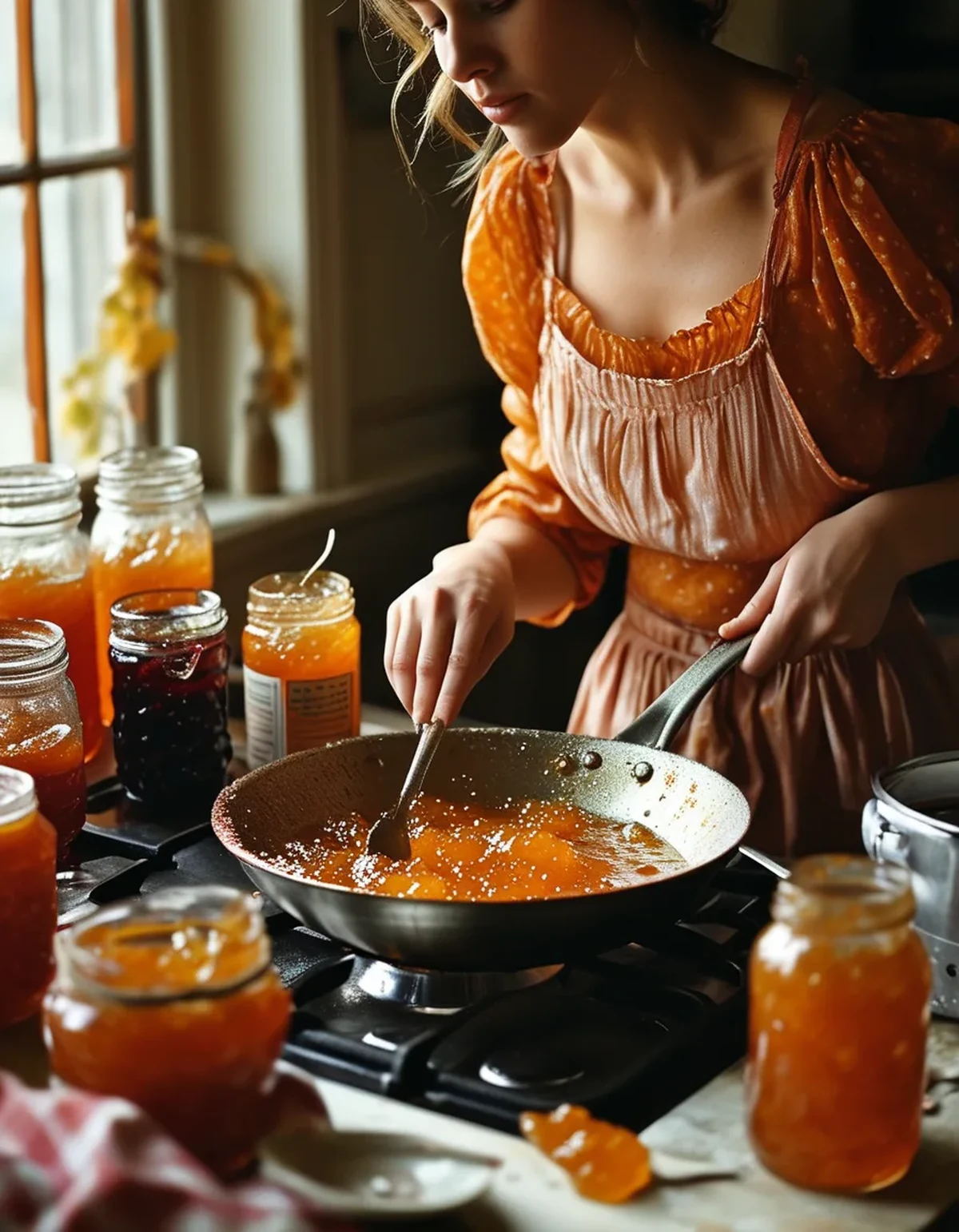
Evaporation happens at the surface, so the rate depends directly on how much surface area the liquid exposes. A wide pan gives the same volume of fruit a much larger surface than a tall narrow pot does.
That difference can be several-fold, which means the wide pan reaches setting concentration substantially faster. Recipes state a time because they have to state something, but the time is only accurate for whatever pan the recipe developer used. In a narrower pot, that same time leaves you well short of concentration — the jam isn’t undercooked in duration, it’s under-evaporated.
What actually determines the set, then?
Three things in the right ratio: pectin, acid, and sugar concentration. Pectin forms a gel network only when sugar concentration is high enough and pH is low enough.
Boiling drives water off, which raises sugar concentration until it crosses the threshold. The setting point is a concentration, not a time — which is why the reliable tests are all measuring the state of the jam rather than the clock. Prolonged boiling past the point of set also degrades pectin, so more time is genuinely not a safe default fix.
Which set test is actually reliable?
In descending order of reliability: a thermometer, the cold plate test, then the spoon sheet test.
A thermometer reading around 220°F (about 105°C) at sea level corresponds to the sugar concentration needed for a standard pectin set. This is the most reproducible test, with one important caveat: boiling point drops with altitude, roughly 1°F per 500 feet, so the target temperature is lower the higher you are.
The cold plate test — a spoonful onto a plate from the freezer, pushed with a fingertip after a minute to see if it wrinkles — works well and needs no equipment. The spoon sheet test is the least reliable of the three and the most commonly taught.
Myth vs Fact: Jam Setting
Myth: Jam that didn’t set was undercooked, so cook it longer next time. Fact: Sometimes. But extended boiling degrades pectin, so a long slow boil can fail to set for the opposite reason. Fast, hard boiling in a wide pan is the more reliable path.
Myth: More sugar always means a firmer set. Fact: Sugar is one leg of a three-part ratio. Too much sugar relative to pectin and acid produces a syrupy, over-sweet result rather than a firmer gel.
Myth: All fruit has enough natural pectin. Fact: Pectin content varies enormously — apples, citrus peel, and currants are high; strawberries, peaches, and cherries are notably low and usually need help.
Myth: Doubling the recipe just takes twice as long. Fact: Doubling volume in the same pan increases depth without increasing surface area, so evaporation gets disproportionately slower. This is the single most common cause of a failed batch among people who’ve made the recipe successfully before.
Myth: You’ll know within an hour whether it set. Fact: Many jams continue firming for 24-48 hours as pectin fully networks. Judging at bedtime and recooking in the morning ruins a lot of jam that was going to be fine.
How do you actually choose the pan?
Wide and heavy-bottomed, with the fruit no more than a few inches deep, and never more than about a third full to allow for the violent foaming that comes with a hard boil.
Specifically: a wide preserving pan or a large heavy skillet-style pan beats a stockpot for every batch size that fits. Heavy construction matters because the high sugar concentration scorches easily on thin bases, and a scorched batch is unsalvageable in a way an unset batch isn’t. If you only have a stockpot, split the batch into two pans rather than accepting the depth.
FAQ: Jam Setting Questions, Answered
Can I fix jam that didn’t set?
Usually yes. Recook in small batches with added acid (lemon juice) and, if needed, added pectin per the pectin package instructions — but wait a full 48 hours before deciding it failed.
Does altitude really change the target temperature?
Yes. Water boils lower at altitude, so the sugar concentration corresponding to a given temperature is different. Subtract roughly 1°F per 500 feet from the sea-level target.
Should I use added pectin or rely on the fruit?
For low-pectin fruit — strawberries, peaches, cherries — added pectin makes results far more consistent. High-pectin fruit like apples and citrus generally doesn’t need it.
TL;DR:
- Set is determined by concentration, not by cooking time
- Pan width controls evaporation rate, so the same recipe behaves differently in a different pot
- Use a thermometer (about 220°F at sea level) or the cold plate test, not the spoon test
- Doubling a recipe in the same pan is a common and avoidable failure
- Wait 24-48 hours before declaring a batch unset
Write the pan down next to the recipe. It’s the variable that quietly decided the outcome all along.
Keep Reading
This article is for general informational purposes only and is not medical advice. Always consult a qualified health professional for guidance specific to you.