Why Water Bath Canning Times Can't Be Shortened Just Because You're Processing a Smaller Batch
Quick Answer: Water bath processing time is determined by how long it takes heat to fully penetrate to the center of each individual jar and hold long enough to destroy harmful microorganisms, and that penetration time depends on jar size and recipe density, not on how many jars are in the canner at once, so a smaller batch of the same jar size still needs the full recommended processing time.
Batch size changes how many jars you’re managing, but it doesn’t change how long heat takes to reach the center of any single one of them.

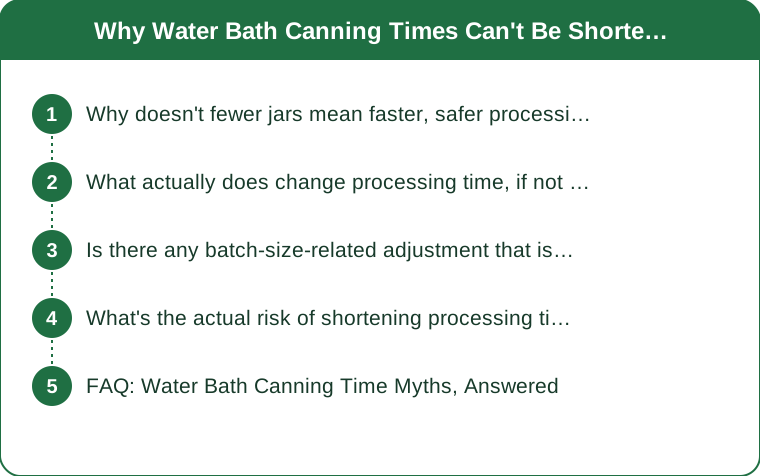
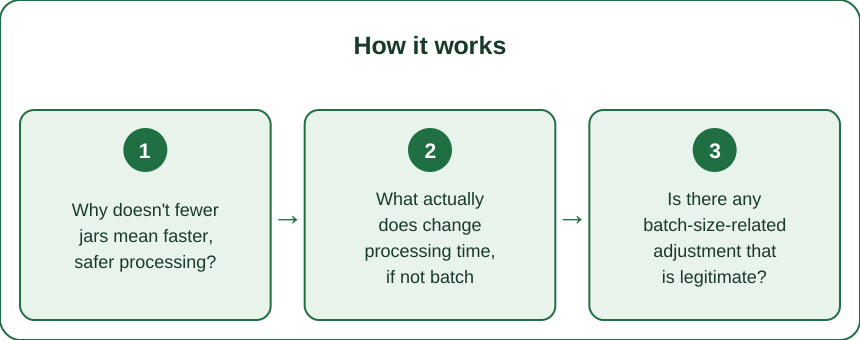
Why doesn’t fewer jars mean faster, safer processing?
Each individual jar heats independently based on its own size and contents, regardless of how many other jars share the canner. Processing time is calculated for the slowest-heating point within a single jar of that size, which doesn’t change based on total jar count.
What actually does change processing time, if not batch size?
Jar size (pint versus quart), recipe density and acidity, and altitude are the real variables that affect required processing time — these determine how long heat takes to penetrate and how much time is needed to ensure safety at the jar’s center.

Is there any batch-size-related adjustment that is legitimate?
Altitude adjustment is legitimate and required, since water boils at a lower temperature at higher elevations, requiring longer processing times regardless of batch size — this is unrelated to how many jars you’re processing at once.
What’s the actual risk of shortening processing time based on batch size assumptions?
Under-processed jars can allow harmful bacteria, including botulism-causing Clostridium botulinum spores, to survive, since the safety margin in tested canning recipes accounts for worst-case heat penetration in a single jar, not an average across a full canner load.
FAQ: Water Bath Canning Time Myths, Answered
Does using a larger canner with more water change processing time?
No — the water volume and canner size don’t factor into the tested processing time for a given jar size and recipe; only jar size, recipe, and altitude do.
Can I combine a partial batch of pints with a partial batch of quarts in one canner run?
Yes, as long as both jar sizes are processed for their own correct, full time — process for the longer of the two required times if running them together.
Is there a safe way to process a very small batch, like just two or three jars?
Yes — a small number of jars still requires the full recommended processing time for that jar size and recipe; there’s no safe shortcut based on quantity.
TL;DR:
- Processing time depends on heat penetration to a single jar’s center, not total jar count
- Jar size, recipe density and acidity, and altitude are the real variables affecting time
- Shortening time based on batch size assumptions isn’t supported by tested safety margins
- Small batches still require the full recommended processing time for that jar size
Keep Reading
This article is for general informational purposes only and is not medical advice. Always consult a qualified health professional for guidance specific to you.