Why Where You Store Jars Matters as Much as How You Sealed Them
Quick Answer: Storage conditions determine how long preserved food keeps its quality and, in some cases, its safety. The three variables that matter are temperature, light, and temperature fluctuation. A cool, dark, stable spot can keep quality high for a year or more; a warm cupboard above the stove or a sunny shelf can degrade color, texture, and nutrients within months, and repeated temperature swings can stress seals.
The processing gets all the attention because that is where the safety rules live. Storage is where the quality is won or lost.
What does heat actually do to a sealed jar?
It accelerates every chemical reaction inside, and none of them are ones you want.
A sealed jar is not inert. Enzymes are largely deactivated by processing, but non-enzymatic reactions continue — browning reactions, oxidation of any residual oxygen in the headspace, breakdown of pigments and vitamins, and gradual softening of pectin structures.
All of these roughly double in rate for every 18 degrees Fahrenheit of temperature increase, which is the general rule of thumb for chemical reactions. A pantry at 50 degrees and a cupboard at 85 degrees are not slightly different environments. They are different by a large multiple in how fast quality degrades.
The practical signs are familiar to anyone who has stored jars badly. Peaches that go from golden to brown. Pickles that soften. Jams that darken and develop a slightly caramelized flavor. Green beans that lose color. None of these necessarily indicate a safety problem, and all of them indicate the jar was stored too warm.
There is a safety dimension too, though it is narrower. Very warm storage — above about 95 degrees — can, in the case of a marginal seal, contribute to spoilage, and it can encourage any surviving heat-resistant organisms in a low-acid product. This is why storage guidance for home canning consistently specifies a cool location rather than treating it as a quality preference.
The recommended range is generally between 50 and 70 degrees Fahrenheit, with the cooler end preferred. Most kitchens exceed that for months of the year.
Why does light matter if the jar is sealed?
Because glass does nothing to stop it, and light drives degradation independently of temperature.
Light — especially direct sunlight, but fluorescent light too — breaks down pigments and vitamins directly. Anthocyanins, the compounds that make berries and red fruits their color, are particularly light-sensitive. A jar of strawberry jam on a sunny windowsill can visibly fade in weeks, and the flavor changes alongside the color.
Vitamin C and several B vitamins degrade under light exposure. Fats in any product containing them go rancid faster.
There is also a compounding effect that people miss. A jar in direct sun is not just receiving light — it is also getting hotter, sometimes substantially. A sealed glass jar in a sunbeam behaves a little like a small greenhouse, and the internal temperature can run well above room temperature.
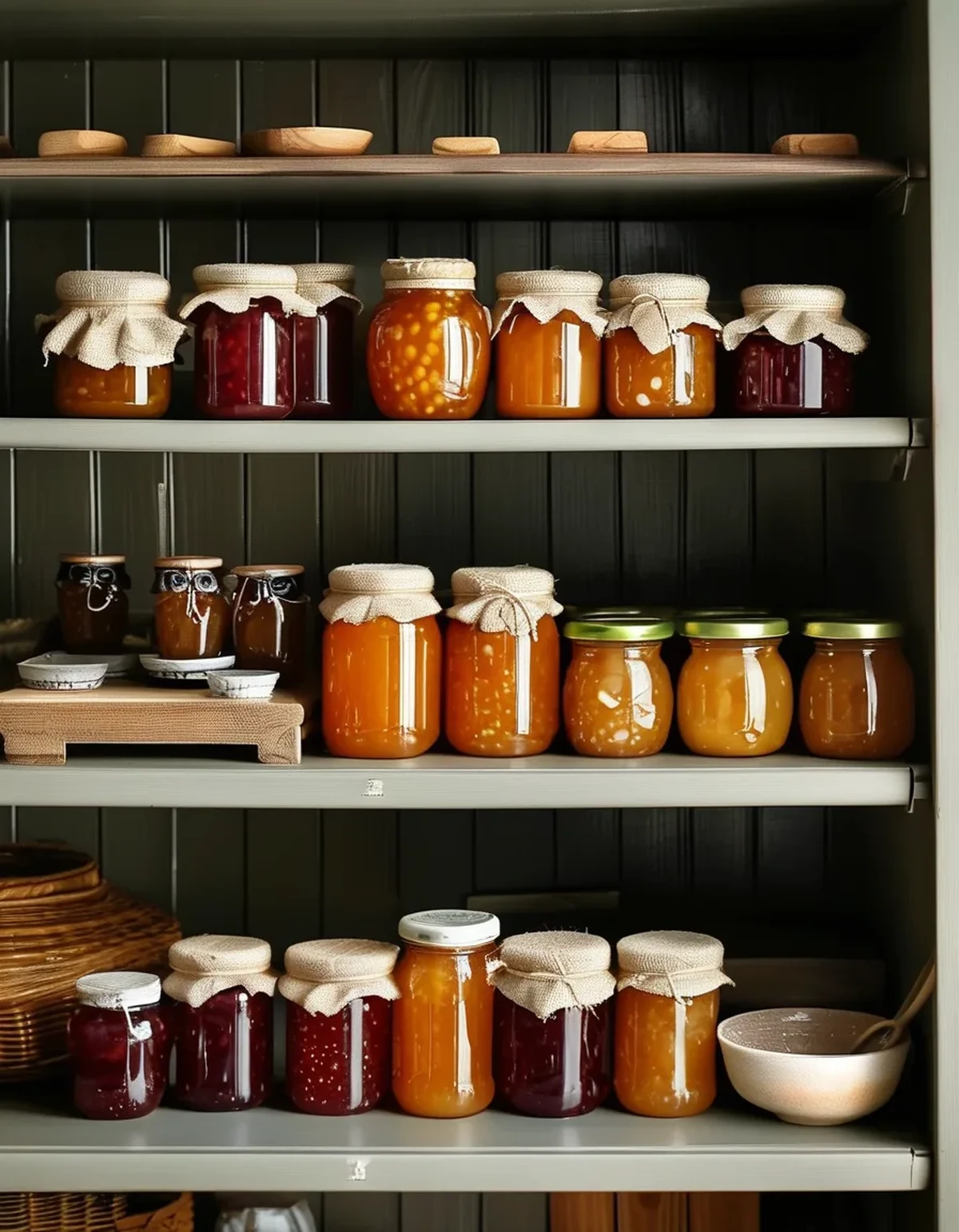
This is why the display shelf is such a common mistake. Home preserves are beautiful and the instinct to show them off is entirely understandable, and an open kitchen shelf is usually warm, lit, and near the stove.
The compromise most people land on: keep a few jars out for display and rotate them into use quickly, and keep the actual store somewhere dark. Treat the displayed jars as the ones you will eat first, not the ones you are keeping.
What Nobody Tells You About Jar Storage
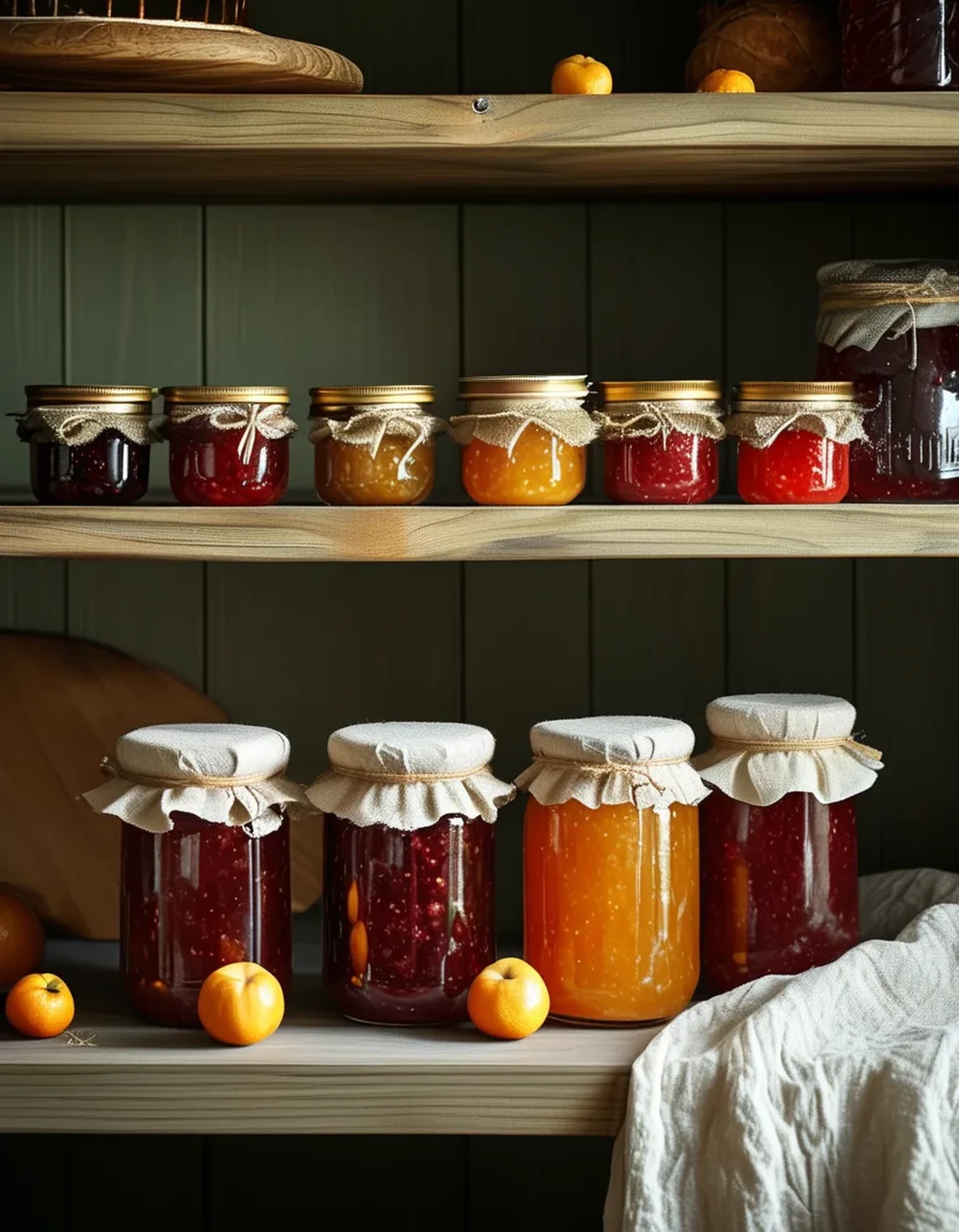
Remove the screw bands before storing. This is standard guidance and it is skipped constantly. A band left on can hold a failed seal in place so it looks intact, hiding a spoiled jar. It can also trap moisture against the lid and rust. Store jars with the sealing lid only, and keep the bands separately.
Temperature swings are worse than a steady warm temperature. Repeated expansion and contraction of the headspace air stresses the seal over time. A garage that goes from 40 degrees at night to 90 in the afternoon is harder on jars than a steady 75-degree cupboard.
The cupboard above the stove is the worst spot in most kitchens. It collects heat from cooking continuously, and it is often the spot people choose because it is convenient.
Do not stack jars more than two high, and never stack directly on lids. Weight on a sealing lid can compromise the seal, particularly as the jar ages. If you must stack, put a board or a shelf liner between layers so the weight travels through the rims rather than the lid centers.
A basement is usually excellent and sometimes not. Cool and dark is ideal; damp is not, because moisture rusts lids and destroys labels. If your basement is humid, jars are fine but bands and labels will suffer, and rust on a lid edge can eventually compromise it.
Label with the date, not just the contents. Everyone knows what is in the jar for the first two months. Nobody knows in February which of two identical jars of tomato sauce was from which batch.
Where should jars actually go, and how long do they keep?
The best available spot in most homes, ranked, plus realistic timelines.
Best: an interior closet, a basement shelf, or an under-stairs cupboard — anywhere with no exterior wall, no light, and stable temperature. Interior spaces buffer against seasonal swings far better than anywhere against an outside wall.
Good: a lower kitchen cabinet away from the stove and dishwasher, ideally on an interior wall. Lower is better than higher because heat rises.
Poor: garages, attics, and sheds. These swing dramatically with the season and are the most common cause of large-scale quality loss. A summer attic can exceed 120 degrees.
Poor: above the refrigerator or near any appliance vent. Constant low-grade heat.
Worst: open shelving in a sunny kitchen. Light and heat together.
On timelines, the standard guidance for home-canned goods is best quality within one year, and generally safe beyond that if the seal is intact and storage was appropriate. Quality declines noticeably in the second year even under good conditions. High-acid products like jams and pickles hold quality better than low-acid vegetables.
Stored badly, a jar can be visibly degraded in three to six months while still being sealed. That is the gap this article is about — the difference between a safe jar and a good one.
For a late summer canning season specifically, this is the moment it matters most. You are putting up the year’s fruit now, and where those jars sit for the next twelve months is being decided this month. Choosing the cool interior spot now rather than the convenient warm one is a decision you get to make once and benefit from all year.
Always follow tested recipes and current food safety guidance from a reliable source for processing itself. Discard any jar with a failed seal, an unusual smell, visible mold, or bubbling, without tasting it.
FAQ: Storage Questions, Answered
Can I store jars in the refrigerator to extend life?
You can, and it is unnecessary for properly processed shelf-stable products and a waste of fridge space. Refrigeration is required for refrigerator pickles and any product not processed for shelf storage.
Do jars need to be stored upright?
Yes. On their side, the contents sit against the sealing compound, which can degrade it over time and makes it harder to spot a seal failure.
How do I check a jar after months in storage?
Press the center of the lid — it should not move or flex. Look for any leakage, rust at the edge, cloudiness that was not there before, or bubbles rising in the jar. If anything is off, discard rather than taste.
Is a slightly darkened jam still good?
Usually yes in safety terms and reduced in quality. Darkening is typically oxidation and heat exposure. If the seal is intact and there is no off smell or mold, it is generally fine to eat, just past its best.
TL;DR:
- Storage temperature and light degrade preserved food quality even in a perfectly sealed jar.
- Aim for a cool, dark, stable spot — interior closet or basement beats any kitchen cabinet, and above the stove is the worst option.
- Remove screw bands, avoid stacking on lids, and label with dates.
- Best quality is within one year under good conditions; poor storage can degrade a jar visibly in three to six months.
This month’s jars are choosing their home for the next year. Put them somewhere cool and dark now rather than somewhere convenient.
Keep Reading
This article is for general informational purposes only and is not medical advice. Always consult a qualified health professional for guidance specific to you.